Your AI agents are already running – and so is the meter. Every prompt, every tool call, every retry costs real money. For most enterprises that have moved beyond single-agent experiments, that spend is growing fast. Some of it is unavoidable. But a meaningful slice – the part that comes from agents repeating work they already did, reading files they already read, and producing verbose output that no one asked for – is pure waste. Ethosure is designed, in part, to eliminate exactly that waste.
The following is a worked example a CFO can re-run with their own numbers. All figures are illustrative ballpark assumptions, not guarantees or benchmarks.
Where the waste comes from
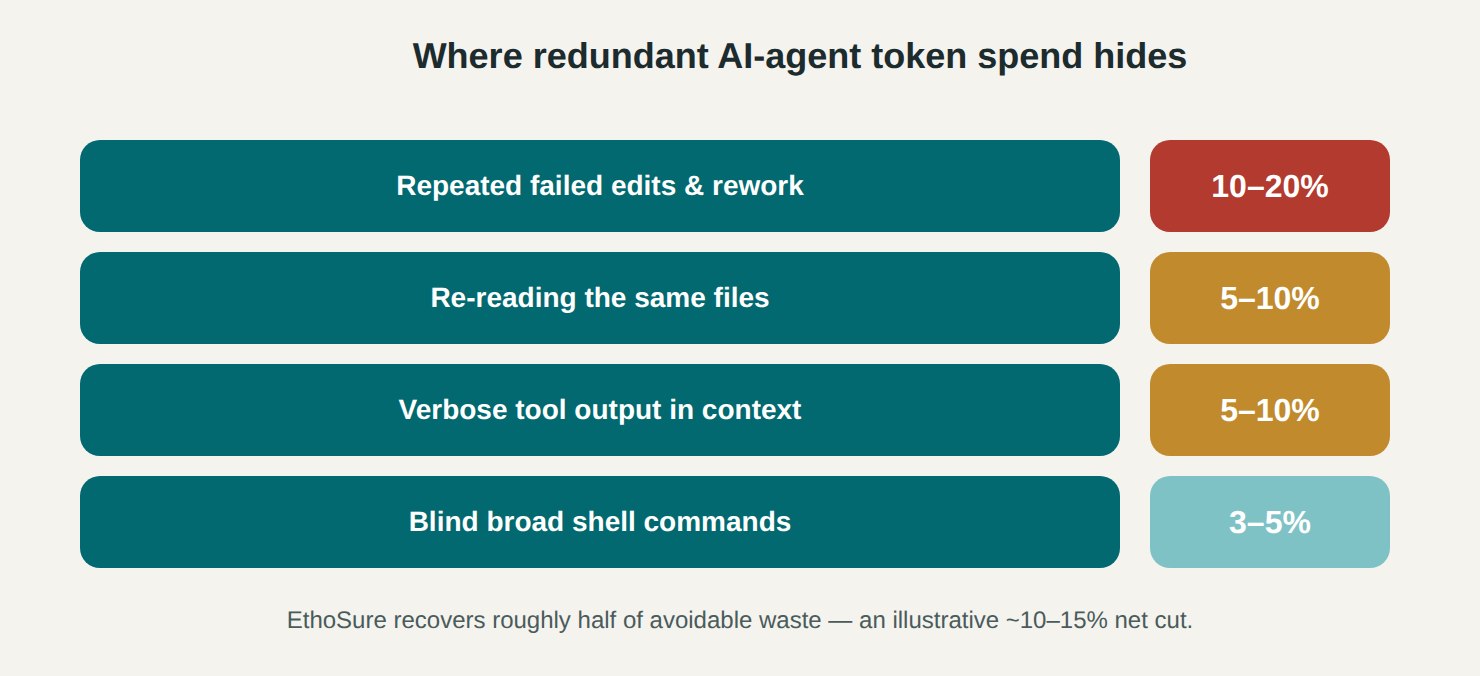
When AI agents operate without a policy-enforcement layer, token spend accumulates in four identifiable buckets.
- Rework loops. An agent makes a non-compliant change. Because nothing caught the violation before the change was executed, the problem surfaces later – in a code review or a CI failure. The agent re-generates a fix, re-reads context, and tries again. Estimated waste: 10–20% of agent token spend.
- Redundant context. Agents re-read the same files in the same session because they have no shared memory of what they already retrieved. Estimated waste: 5–10%.
- Verbose tool output. Logs and diagnostics get dumped in full into the model context. Estimated waste: 5–10%.
- Blind broad commands. Agents run wide shell commands without first checking what the policy-compliant path looks like. Many calls produce output that is immediately discarded. Estimated waste: 3–5%.
Combined conservatively, around 20–30% of agent token spend is avoidable waste.
A worked ROI example
Assumptions (state these plainly; substitute your own):
- 150 developers and knowledge workers using AI agents.
- 40 use agents heavily day-to-day (active agent seats).
- Each active seat drives approximately 1.5 million tokens per day across prompts, tool outputs, and retries.
- Blended token cost: $6 per million tokens (mix of premium and cheaper models).
Per active seat:
- 1.5M × $6/1M = $9/day
- $9 × 22 working days = $198/month
- $198 × 12 = $2,376/year
40 seats:
- 40 × $2,376 = approximately $95,000/year in raw agent token spend
- this is estimated as a reasonable $90K–$120K/yr band for a medium organization
What Ethosure removes
Ethosure’s enforcement core addresses each waste bucket directly.
Block-before-execute eliminates rework loops. When the enforcement layer blocks a non-compliant action before it runs, there is no downstream rework cycle.
Code-intelligence memory attacks rework loops and redundant context. The system tracks repeated edits, repeated reads, repeated failures, and remediation outcomes. Before an agent re-reads a file, it can query what was already learned and what the enforced repair path looks like.
Agent Proxy output compression and token-budget transforms cut verbose output. Tool outputs are capped at configurable head/tail line and token budgets before entering the model context.
MCP-first workflow cuts blind commands. Agents ask the policy system what to do before running broad shell commands. Fewer blind calls means fewer wasted tokens.
Conservative assumption: Ethosure recovers roughly half of the avoidable waste in year one as teams ramp. That implies a net reduction of approximately 10–15% of total agent token spend.
Applied to the example:
- 10–15% of $95,000 = $9,500–$14,000/year saved in direct token cost for this medium organization.
- At 100 active seats (approximately $240,000 in annual token spend), the same 10–15% reduction produces $24,000–$36,000/year.
The bigger number beside the savings
Token-cost reduction is the operating argument – it shows Ethosure can pay for itself through efficiency alone. The more significant financial case sits in risk avoidance.
According to the IBM Cost of a Data Breach 2025 report, the average data breach in financial services costs $5.56 million. The same report found that 97% of organizations that experienced an AI-related breach lacked AI access controls, and 63% had no AI governance policy. A single incident of that scale dwarfs several years of token savings.
The soft savings are also real: fewer incident-driven rework hours, faster audit preparation, less time gathering screenshots before a regulatory review. These are harder to put on a spreadsheet but visible to anyone who has lived through an audit scramble.
How to use these numbers
Take your total annual agent token spend. Estimate the share that falls into the four waste buckets. Apply a conservative recovery rate. Even a one-third recovery of avoidable waste produces a straightforward operating case.
The risk-avoidance case requires a different question: could your agent fleet produce an audit trail that satisfies a regulator today? For most enterprises, the honest answer is not yet. That is the problem Ethosure solves alongside the token savings – and it is the reason the governance layer matters well beyond its operating-cost story.