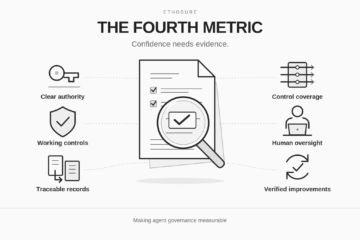
The Fourth Metric: Making Agent Governance Measurable
A response to Alberta’s Velocity White Papers: six practical measures that connect agent governance to authority, control performance, human oversight and evidence that others can examine.
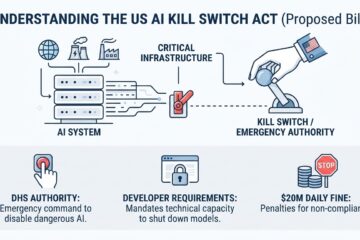
Between July and September 2026, four federal AI shutdown proposals and an active state-legislative track emerged. They vary in who holds authority and what triggers action, but they share a technical substrate. Five requirements determine whether any shutdown regime, statutory or self-imposed, can be enforced, evidenced, and defended under scrutiny.
Enterprises and governments are no longer piloting AI. They are embedding it into decisions, code, and customer contact. Yet three out of four organizations still cannot move AI reliably from pilot to production, and new regulation is arriving faster than most internal controls. Ethosure exists to close that gap. (Note: you Read more
RSAC 2026 marked the moment agentic AI moved from experimentation to operational reality. The threat surface has moved with it. This is the priority stack the world’s security leaders are being asked to build, in order, in 2026 and 2027. The RSAC 2026 signal is unambiguous: agentic AI is a Read more
The world is not converging on a single AI law. It is converging on a set of expectations: identify AI use, manage risk, disclose to users, and prove it. This is where the major jurisdictions stand as of August 2026 Whether it arrives as a horizontal act, a sectoral rulebook, Read more
A dated map of the AI regulations that have already shaped enterprise practice, the obligations that are live right now, and the compliance dates already written into law. Every entry cites a named regulator or a published statute. Regulation is arriving in overlapping waves, not a single deadline. The Article Read more
Two very different maturity curves. Federal civilian agencies are being pushed by executive mandate to embed governance into every AI deployment. Enterprises are still treating governance as a compliance task, and progress has flattened since 2024. This is what the divide looks like in 2026. (Note: you can download Read more
Unlike healthcare or financial services, post-secondary education has no dedicated AI regulator with enforcement powers. What exists is a growing library of voluntary principles and departmental letters. The consequence is that every campus is writing its own rulebook, and every faculty of law, medicine, and education is grading it in Read more
EY’s Trust as Architecture study finds that resilient enterprises stop treating trust as brand narrative and start engineering it into how AI is built, procured, and operated. This is what the stack looks like when it works; this is Ethosure’s position: policy as code, trust as architecture. Some statistics to Read more
The FDA has authorized more AI-enabled medical devices than any other regulator in the world. The rules governing how they are updated, disclosed, and monitored are being rewritten in real time, and not always in the direction of stronger oversight. 1,451: FDA-authorized AI/ML devices, cumulative through Dec 2025 76%: Share Read more