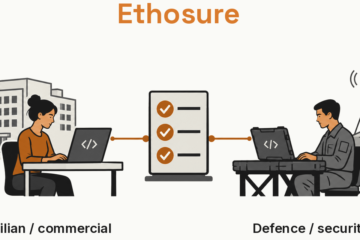
Dual-use AI governance: Ethosure in business and defence
One governance foundation for civilian and defence applications: how Ethosure brings policy enforcement and supervision to AI-assisted work.

Two very different maturity curves. Federal civilian agencies are being pushed by executive mandate to embed governance into every AI deployment. Enterprises are still treating governance as a compliance task, and progress has flattened since 2024. This is what the divide looks like in 2026. (Note: you can download Read more
Unlike healthcare or financial services, post-secondary education has no dedicated AI regulator with enforcement powers. What exists is a growing library of voluntary principles and departmental letters. The consequence is that every campus is writing its own rulebook, and every faculty of law, medicine, and education is grading it in Read more
The FDA has authorized more AI-enabled medical devices than any other regulator in the world. The rules governing how they are updated, disclosed, and monitored are being rewritten in real time, and not always in the direction of stronger oversight. 1,451: FDA-authorized AI/ML devices, cumulative through Dec 2025 76%: Share Read more
A six-layer view of the controls, roles, and reporting lines that a Canadian federally regulated financial institution (FRFI) will be expected to demonstrate under OSFI Guideline E-23, with parallel obligations from the CFPB, NYDFS, and the EU AI Act for cross-border activity. Proper AI governance demands this. (Note: you can Read more
Federal reliability regulators have just made data centres, cryptocurrency mines, and other computational loads a directly registered class under Section 215 of the Federal Power Act. State utility commissions are still catching up. Ratepayers are being asked to fund AI-driven capital plans without a governance layer that says what the Read more