DUAL-USE AI GOVERNANCE
AI workers need supervision.
In business. In defense.
Ethosure fits the dual-use model: commercial AI governance with a credible defense and security application. Its civilian foundation is governance and policy enforcement for AI coding agents, documented in Coding Ethos. Global Affairs Canada defines dual use around software, technologies, goods and services with a primary civilian or commercial use and a defense, security or intelligence use case. The same core software can serve both, with controls adapted to the buyer.
The operating principle: do not let AI workers be the sole judges of their own work.
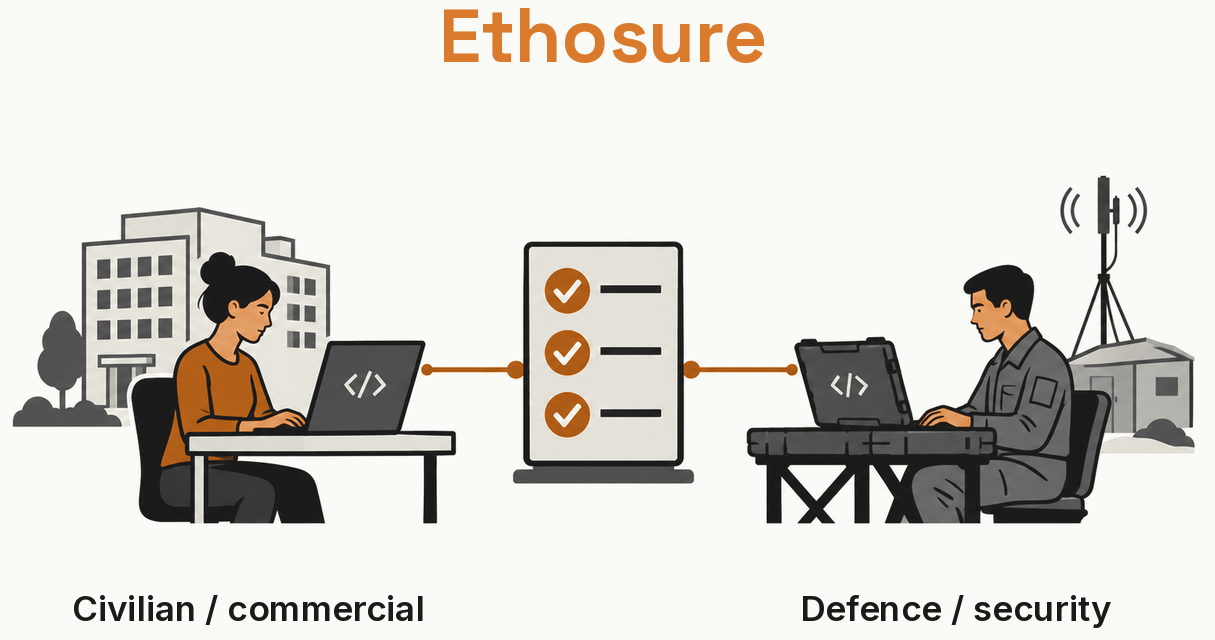
Civilian and consumer value
Businesses can put rules around AI-assisted software work: limit unsafe actions, protect sensitive code and give reviewers a decision trail. Those are the kinds of controls documented in Coding Ethos, with applications across regulated industries and smaller firms.
For individual developers, Coding Ethos offers an open-source route to guardrails for personal projects. Broader protection for personal AI assistants is a future product opportunity.
Defense and security value
Candidate applications include governing AI-assisted development of defense software, logistics applications and defensive cyber tools. The aim is to keep actions within authorized boundaries and make work reviewable.
This approach is relevant to the priorities for accountability, traceability and governability in NATO’s revised AI strategy. It is not a claim of NATO endorsement or certification.
How the protection works
At the action: check coding-agent activity against rules and block prohibited steps, using the controls documented in Coding Ethos. Keep a record so people can review what happened.
In the exchange: observe supported provider traffic, including text arriving piece by piece. Inspection and intervention depend on the configured controls and supported traffic path described in the Agent Proxy documentation. Monitoring is not the same as blocking: enforcement, especially for streamed responses, must be demonstrated in the buyer’s actual workflow.
Inside the model: related Logit Loom components observe generated tokens and adjust the scores behind the next output choice. These advanced controls require a supported runtime and integration; they do not guarantee correct answers, and Logit Loom does not claim that a particular intervention improves model quality.
One foundation, two markets
The investment case is reuse: commercial controls can be adapted for defense and security buyers rather than built twice. Policies, permissions and deployment requirements change; the supervision principle remains.
A practical starting point is one bounded pilot, with agreed tests for policy enforcement, human oversight and evidence quality. That gives buyers a defined way to evaluate the controls in their own workflow.