If you map the tools your organization uses to manage AI agent risk, you will find good coverage at the edges. Governance platforms document policies. Security scanners test code before it ships. Monitoring tools log activity after the fact. What the map reveals – if you draw it honestly – is a gap at the center: at the moment an agent actually takes an action. That moment is the one that matters most, and it is the one the current toolkit consistently misses.
This is not a criticism of any individual tool category. Each was designed for a specific purpose and serves that purpose well. The problem is structural: the current generation of AI risk tools was built around human-authored software and probabilistic AI outputs. Autonomous agents that take consequential actions in real time require a component that does not yet exist in most toolkits – a deterministic enforcement layer at the point of action.
What each category does well
AI governance platforms help organizations define AI policies, assess risk at the model and application level, classify AI systems for regulatory purposes, and track governance posture. Gartner’s 2025 Market Guide for AI Governance Platforms (G00837249) maps this category well. These platforms are excellent at describing what your policy is. They are not designed to enforce it at runtime.
AI guardrail tools sit at the boundary between a model and its inputs or outputs. They use classifier models to identify problematic content – prompt injections, sensitive data, off-policy responses. They are useful for content-layer filtering. Because they rely on probabilistic classifiers, they cannot provide the consistent, reproducible decisions that regulatory frameworks require, and they are not equipped to evaluate structured agent actions (running a shell command, writing a file) against a policy.
RASP, WAF, and API gateways protect conventional application traffic. Web application firewalls inspect HTTP requests; runtime application self-protection monitors conventional application behavior; API gateways manage authentication and routing for service-to-service traffic. All were designed for requests made by or to conventional software. They have no model for the action sequences of an autonomous AI agent operating inside a development environment.
SIEM and monitoring platforms aggregate logs, detect anomalies, and surface security events. They are essential infrastructure – and retrospective by design. They tell you what happened, not what is happening now in the agent’s action path.
The gap at the center
When you overlay these categories on the agent lifecycle, the coverage looks reasonable until you reach the runtime action step. At that moment:
- The governance platform has documented what should happen.
- The guardrail has checked the prompt that preceded it.
- The WAF will log the outbound call if it produces HTTP traffic.
- The SIEM will record it in the event log after it completes.
But nothing is sitting in the action path, evaluating the action against policy before it executes, deciding allow or block, applying a least-privilege sandbox to constrain what the approved process can touch, and recording a tamper-evident decision.
That is the enforcement layer. It is not a new name for any category above. It is a distinct component the current toolkit does not contain.
Why the gap has been tolerable – until now
The enforcement layer gap has been tolerable because, until recently, agents were not doing things with serious consequences. Agents generating text and answering questions do not need an enforcement layer in the way that agents writing code and executing commands do. As agents have moved from advisory to operational roles – from suggesting an action to taking it – the gap has become both more visible and more expensive.
IDC’s February 2026 report on Operationalizing Trust for Agentic AI describes the runtime guardian model as a critical integration pattern for enterprise agent deployment, identifying SDK fusion, sidecar deployment, API gateway integration, and MCP proxy as the architectural shapes that enforcement takes at runtime. These patterns exist because the gap is now recognized as a real infrastructure problem.
What filling the gap requires
An enforcement layer requires several properties that must coexist:
- Determinism. The enforcement decision must produce the same result given the same action, policy, and context every time. Probabilistic classifiers cannot meet this requirement.
- Position in the path. The layer must intercept actions before they execute, not observe them after. A guardian that watches from the side is a monitor; one that sits in the path is a control.
- Fail-closed behavior. When evaluation is indeterminate or input is malformed, the default must be to block, not to allow.
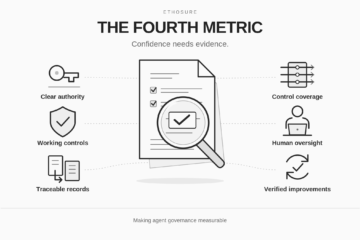
- Evidence. Every decision must produce a tamper-evident record tied to the specific policy rule, the action evaluated, and the context of the decision.
- Sandbox. An approved action should execute in a constrained environment – least-privilege access, no unexpected network calls, defined resource limits.
The current tool landscape covers the lifecycle at the edges. The enforcement layer fills the gap at the center.