AI agents are useful because they act. They write code, run commands, query databases, and make changes to systems – often faster than any human reviewer can follow. That speed is the whole point. But it creates a problem most organizations are only beginning to confront: if an agent does something it should not have done, when did it happen, why did no one stop it, and where is the evidence you were exercising any control at all?
Auditors are not asking these questions in most sectors yet. They will be. For organizations in regulated industries – financial services, healthcare, critical infrastructure – the clock is already running.
Ethosure is designed to answer both questions at once: keep the agent on course, and produce a record that proves it.
What an auditor actually needs
When a regulator reviews your AI governance posture, they are looking for two things. First, a control: something that sits between the agent and the consequences of its actions, capable of allowing, redirecting, or stopping what the agent does. Second, evidence: a record showing that the control was active at the relevant moment and that its decisions trace back to a stated policy.
A spreadsheet of AI policies satisfies neither requirement. A post-hoc log of what an agent did satisfies the second but not the first. What is needed is a control that is in the path – not monitoring from the side – and that produces a tamper-evident record as a by-product of doing its job.
One decision point, four outcomes
Ethosure places a deterministic guardian directly in the agent’s action path. Before an agent executes any consequential action – writing a file, running a command, calling a service – it passes through the enforcement layer.
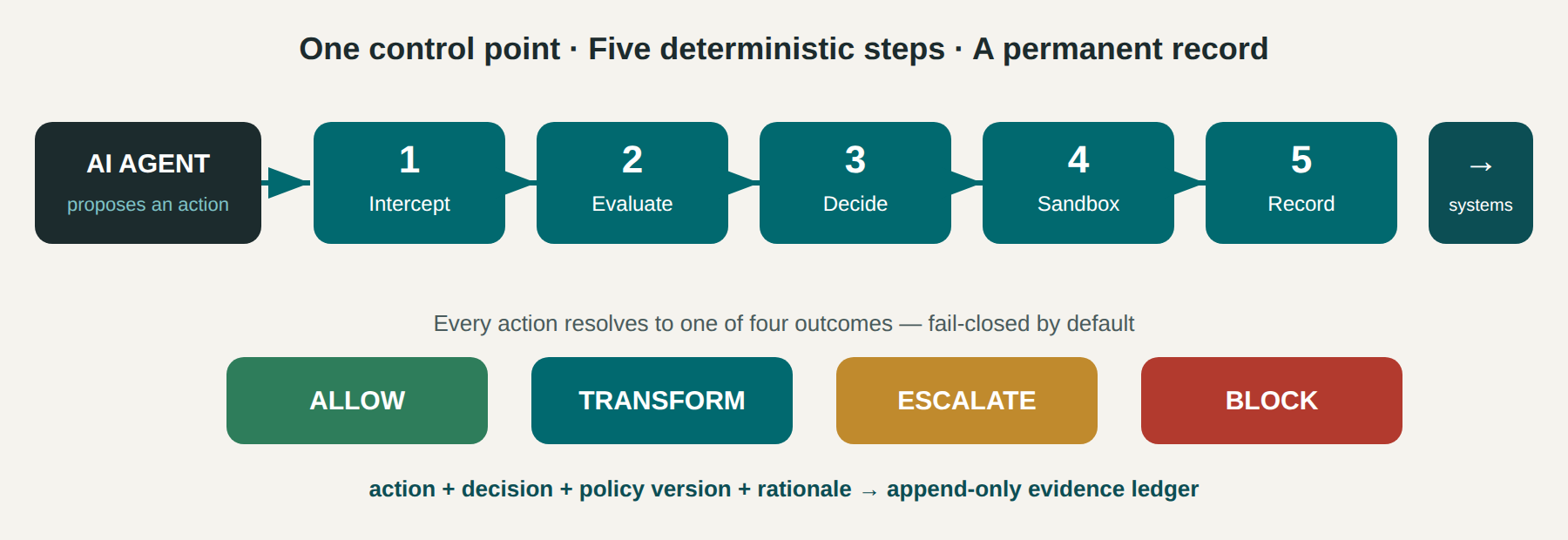
The layer evaluates the action against compiled policy and returns one of exactly four dispositions:
- Allow: the action is compliant and proceeds.
- Transform: the action can be made compliant with a defined rewrite. The agent receives the transformed version and continues.
- Escalate: the action requires human review before it proceeds.
- Block: the action violates policy and is denied.
This is not probabilistic filtering. The evaluation is deterministic: identical action, identical policy, identical context produces the identical decision, every time. That determinism matters to auditors because it means the control is predictable, testable, and explainable.
The system is also fail-closed. If evaluation is indeterminate – input malformed, context ambiguous – the default is block, not allow. A control that fails open is not a control.
The evidence ledger
Every decision the enforcement layer makes is recorded in an append-only evidence ledger. The record captures the action, the policy rule it was evaluated against, the disposition, and the precise context of the decision. It cannot be quietly revised after the fact.
The output format is SARIF (Static Analysis Results Interchange Format), a structured standard that maps directly to the categories regulatory frameworks use. Each finding includes policy identifiers, skill references, and remediation metadata. Every finding is auditable back to a specific trace, file, symbol, policy rule, and SARIF result.
When an auditor asks for evidence of control over AI agents, Ethosure produces a report – not a folder of screenshots assembled the week before the audit. The evidence is mapped to NIST AI Risk Management Framework, ISO/IEC 42001, and the EU AI Act. The EU AI Act becomes enforceable in August 2026, with penalties under Article 99 reaching up to €35 million or 7% of global annual turnover. Ethosure evidence maps directly to its documentation requirements.
Why monitoring is not the same as control
Many organizations believe they are managing their AI agents because they can see what the agents are doing. Observability platforms and monitoring dashboards are valuable – but watching something happen is not the same as controlling whether it happens.
The Gartner 2025 Market Guide for AI Governance Platforms (G00837249) distinguishes between governance tools that describe risk and tools that intervene at runtime. Gartner uses the term “guardian agents” for this blend of AI governance and AI runtime enforcement – the category Ethosure operates in. Most enterprises today have the former. They are missing the latter.
Ethosure’s enforcement layer is not a monitor beside the pipeline. It is a gate in the pipeline. Bypass attempts through alternative Git paths, hook-skip flags, or subprocess indirection are treated as enforcement failures, not edge cases.
What this means in practice
For the CISO: a deterministic control point and a least-privilege runtime sandbox constraining what an approved process can actually access.
For the compliance officer: a real-time audit trail mapped to the frameworks you report against. Audit preparation shrinks from days to hours.
For the head of engineering: agents can move fast inside defined guardrails. The enforcement layer does not slow a compliant agent. It only stops – and records – what should not have happened.
For the board: when someone asks “how do you know your agents are doing what they are supposed to do?” the answer is “we have evidence” rather than “we believe so.”