Boards are asking. Not in a casual, exploratory way – in the way that follows a compliance breach, a regulatory inquiry, or a news story about an AI system doing something it should not have done. The question landing in board meetings now is direct: who in this organization is accountable for our AI agents?
Most organizations do not have a clean answer. That is itself a governance failure.
Why the accountability question has escalated to the board
The shift from AI tools to AI agents is the reason. A predictive model that recommends a loan decision is consequential, but a human makes and owns the final call. An agent that autonomously executes a sequence of actions – drafts a communication, modifies a financial record, deploys a code change, calls an external API – is different. The chain of human oversight is thinner, the speed of action is higher, and the potential for compounding errors is real.
Regulators have noticed. The EU AI Act, enforceable from August 2026, imposes penalties under Article 99 of up to €35 million or 7 percent of global annual turnover for serious violations. In Canada, OSFI’s AGILE framework explicitly addresses AI-related operational risk, and FINTRAC has levied a record single penalty of $176.9 million – part of an enforcement posture that has exceeded $200 million in total. The IBM Cost of a Data Breach 2025 found that the average breach in financial services reached $5.56 million, before any regulatory sanctions.
These are board-level numbers.
The accountability vacuum
AI agent deployment tends to happen in layers no single person owns end-to-end. Engineers deploy agents for specific tasks. Business units expand their use. Procurement selects platforms. IT manages credentials. Legal sets policy. Risk management maintains oversight.
Each group has partial accountability. None has complete accountability. When something goes wrong, the question of responsibility produces a cross-functional meeting rather than a clear answer.
Boards understand this structure. What they are asking for is a control architecture that makes the question answerable: Who decided what the agent was allowed to do? What evidence exists that the policy was enforced? What would a regulator find if they asked the same questions?
What accountability requires technically
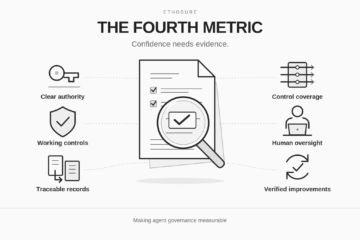
Accountability without evidence is an assertion. For a board or regulator, accountability requires three things that are technical before they are organizational.
A versioned policy. The scope of every agent’s permitted actions must be documented in a form that can be read, audited, and version-controlled. A policy that lives as a verbal understanding between a team lead and an engineer is not a policy for governance purposes. Both NIST AI RMF and ISO/IEC 42001 require documented, maintained governance artifacts.
Runtime enforcement. A policy document does not prevent an agent from acting outside its scope. Enforcement requires a technical control that evaluates agent actions against the policy *before they execute* – and blocks or escalates violations. Without this, the policy is advisory. Boards have learned through compliance history that advisory controls do not survive regulatory scrutiny.
An immutable audit trail. When a regulator or board audit asks what an agent did, the answer must come from a tamper-evident record, not a reconstructed narrative. This means append-only event logs capturing what action was taken, what policy was evaluated, what decision was made, and what the outcome was – linked to the policy version in force at the time.
Ethosure’s answer to the accountability question
Ethosure’s enforcement architecture – built on the open-source `coding-ethos` project (OpenSSF Best Practices Silver badge, project #12737) – was designed with this structure in mind. Policy is compiled from named engineering principles into a versioned `policy-bundle.json` that constitutes a single source of truth for every agent operating under it. Every action is evaluated by a deterministic CEL-based policy engine; the outcome is recorded in an append-only JSONL evidence ledger with full provenance – which policy, which version, which action, which decision, when.
The evidence ledger is mappable to NIST AI RMF controls and ISO/IEC 42001 requirements. When a board audit asks for the governance record, the answer is a structured report, not a folder of screenshots.
The conversation the board actually needs
The productive board conversation about agent accountability is not “what can go wrong?” – boards already know. It is “what controls do we have, and how do we know they are working?”
That question has a better answer than most boards currently receive. But getting there requires building enforcement infrastructure before the regulator asks. The organizations that have done this work are the ones whose CISOs and CROs can stand in front of the board and answer clearly: here is who is accountable, here is the policy they are accountable for, and here is the evidence that it was enforced.
The board is going to keep asking. The goal is to be ready.