Software products have always had features that were really infrastructure: uptime, security, data integrity. Those features were assumed without being measured – until they failed visibly enough that buyers started demanding specifics. “What is your uptime SLA?” became standard because outages became a differentiator. “How do you handle breaches?” became standard because breaches became public.
Trust in agentic AI is at that inflection point. For the first two years of enterprise agent deployment, trust was assumed – or ignored. That is changing. The organizations now asking “can I actually govern this?” are making trust a procurement criterion. That means it is becoming a product feature.
The shift from assumed to demonstrated trust
The reason trust is becoming a product feature is the same reason security became one: visible failures. An AI agent that exposes customer data, sends an unauthorized communication, modifies a financial record without authorization, or makes a decision a regulator subsequently questions – each event moves trust from an assumption to a requirement.
The IBM Cost of a Data Breach 2025 found that 97 percent of organizations that experienced an AI-related breach had lacked AI access controls, and 63 percent had no AI governance policy – a large population that trusted agents without verifying them.
The EU AI Act, enforceable from August 2026, and Canada’s OSFI AGILE framework both operate on the same logic: trust must be demonstrated, not assumed. The demonstration requires documentation of design, evidence of operation within documented scope, and independently verifiable audit trails – a regulatory expectation with penalty consequences attached.
What makes trust a feature rather than a posture
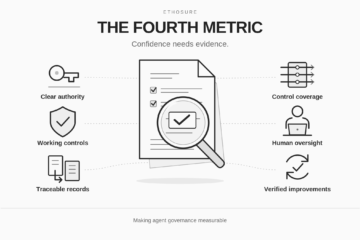
A posture is something you claim. A feature is something you demonstrate. The question a CISO or CRO now asks of any AI vendor is not “how does your system work?” but “what can you show me?” – not a white paper, but a demonstration the architecture is running. Not a policy document, but a record showing the policy was enforced.
This is a higher bar than most AI vendors currently clear. The governance vocabulary is well developed – everyone has a trust framework and an AI ethics page. The evidence layer is sparse. Organizations that can produce, on demand, a structured record of what their agents did and what enforcement outcomes resulted have a demonstrably different product proposition.
The three trust signals that matter to buyers
From an enterprise buyer’s perspective, trust signals fall into three categories with distinct technical requirements.
Provenance: Can you trace any agent action back to its originating policy, the version in effect at the time, and the specific evaluation that produced the disposition? Provenance means the evidence record is not just a log of what happened, but a log of *why* – linked to a versioned artifact that cannot be altered after the fact.
Determinism: Does the same action, evaluated against the same policy, produce the same outcome every time? A governance system that produces different decisions based on model state or prompt phrasing is not a governance system; it is a probabilistic filter. Trust requires determinism because auditors and regulators need to verify behavior, not just observe it.
Non-repudiation: Can the evidence record be produced in a form that cannot be denied or contested? Append-only logs satisfy non-repudiation. An evidence record that can be modified after the fact, or that requires vendor cooperation to produce, does not.
Ethosure’s architecture as a trust product
Ethosure’s enforcement core – the open-source `coding-ethos` project, OpenSSF Best Practices Silver badge (project #12737) – was built around all three trust signals as first-class design requirements.
Provenance is built into the enforcement path: every CEL-based policy decision links to the specific policy bundle version, the rule evaluated, and the action attempted. SARIF output and JSONL evidence carry full provenance metadata as a matter of architecture.
Determinism is guaranteed by design. The CEL evaluator is explicitly prohibited from probabilistic or embedding-based methods in the enforcement path. Identical action, identical policy, identical context – identical decision, independent of the underlying AI model.
Non-repudiation is provided by the append-only evidence ledger. Events are recorded once and cannot be modified. The record is stored locally, under the customer’s control, independently verifiable.
The market signal in the Omdia data
Omdia projects the AI partner services opportunity at $276 billion by 2030, identifying governance and compliance as the top challenge for 45 percent of technology partners deploying agentic AI for enterprise clients. Enterprise buyers are asking the trust questions, and vendors who cannot answer them are hitting a wall. Organizations that clear the trust bar become reference customers; those that fail become cautionary tales cited in regulatory guidance and enterprise RFP requirements.
The practical implication
For organizations deploying agents: trust in your AI program is not a communication strategy or a policy document. It is an architecture choice. Organizations that build enforcement infrastructure, produce tamper-evident audit evidence, and can demonstrate policy compliance on demand have a governance posture that protects them from regulatory exposure, supports board accountability, and enables faster agent adoption.
Trust has always been the foundation of enterprise software. In the agentic era, it is also a product feature. The organizations that build it in – not bolt it on – are the ones whose AI programs survive the next audit, the next regulatory examination, and the next board question.