Canadian financial institutions are navigating a regulatory environment that has never been more demanding – and doing it simultaneously with accelerating AI agent deployments across operations, compliance, customer service, and risk management. Three regulatory frameworks define the stakes: OSFI’s AGILE framework, FINTRAC’s enforcement posture, and PIPEDA. Understanding what each requires – and where current AI deployments create exposure – is the starting point for a defensible governance posture.
OSFI AGILE: Operational risk at the intersection of AI
OSFI’s AGILE framework addresses the operational risk implications of AI in federally regulated financial institutions. It is not primarily an AI ethics document; it is an operational risk management instrument. It covers governance structures, risk appetite, model risk management, and third-party risk introduced by AI vendors.
For agentic AI, AGILE’s model risk management provisions are directly relevant. An AI agent is, in governance terms, a model that takes actions. OSFI expects that models used in consequential decisions have documented validation, monitoring, and oversight. Most model risk frameworks were designed for statistical models producing predictions, not for autonomous agents executing multi-step action sequences. The extension to agents requires deliberate architecture work – it does not happen automatically.
AGILE also emphasizes board and senior management accountability. The framework expects that material AI risks are identified, quantified where possible, and escalated to governance structures with appropriate authority. An organization that cannot produce a current inventory of deployed agents with documented operational controls is not in a defensible AGILE posture.
FINTRAC: The penalty trajectory is instructive
FINTRAC’s record for a single administrative monetary penalty stands at $176.9 million, part of an enforcement posture that has exceeded $200 million in cumulative penalties. These arise from AML/ATF compliance failures – failures to detect, report, or prevent money laundering and terrorist financing.
Canadian financial institutions increasingly use AI agents in AML operations: transaction monitoring, suspicious activity detection, customer due diligence, and reporting. An AI agent that misclassifies transactions, fails to escalate suspicious patterns, or produces reports without adequate traceability creates compliance exposure that FINTRAC assesses against the same standards it applies to any compliance failure – regardless of whether a human or a system caused it.
FINTRAC’s question is not “was this a technology problem?” It is “what controls did you have, and did they work?” An AI agent operating without a documented policy, without runtime enforcement, and without an audit trail is a liability of exactly the kind FINTRAC’s penalty regime is designed to address.
PIPEDA and the data residency dimension
PIPEDA creates specific obligations around the collection, use, disclosure, and retention of personal information. For AI agents that process personal data – which in financial services means essentially every customer-facing agent – PIPEDA requires that processing be authorized, proportionate to purpose, and traceable.
The traceability requirement is the one most current AI deployments fail to meet. If an agent reads a customer file, combines it with other data, produces an output, and takes an action, PIPEDA’s accountability principle requires the institution to explain what data was accessed, for what purpose, and under what authorization. Absent a runtime enforcement layer recording agent data access at the action level, that explanation is not producible.
Quebec’s Law 25 imposes privacy impact assessment obligations and data minimization requirements for automated decision-making systems substantially stricter than federal PIPEDA. The data-residency dimension of these requirements – that personal data about Canadians should remain in Canada – is directly relevant to AI governance architectures routing enforcement decisions through offshore infrastructure.
The practical governance gap
The IBM Cost of a Data Breach 2025 found the average breach in financial services cost $5.56 million, and 97 percent of AI-related breaches occurred at organizations that lacked AI access controls. For a Canadian institution balancing OSFI, FINTRAC, and privacy obligations, an AI-related breach is not just a reputational event; it is a multi-regulator exposure.
The governance gap is consistent across institutions of all sizes: agents deployed for operational benefit, but policy, enforcement, and evidence either absent or existing only in document form. Documents are not controls.
What a defensible Canadian AI governance posture requires
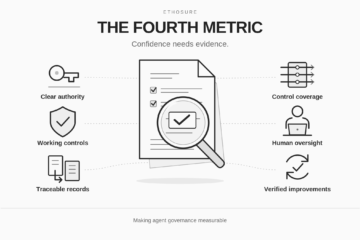
A Canadian financial institution operating AI agents needs to demonstrate four things to its regulators:
Documented scope. Each agent’s permitted actions, data access, and decision authority must be in a versioned policy producible on demand.
Runtime enforcement. Policy must be enforced at the point of action, not reviewed after the fact. A technical control must evaluate agent actions before they execute and block or escalate violations.
Audit-ready evidence. Every material agent action must be logged in a tamper-evident, structured record. Reconstructed summaries do not meet this standard.
Data residency. For Canadian personal data, enforcement infrastructure must operate on-premises or in a Canadian data residency environment. Cross-border flows for governance decisions create their own regulatory exposure.
Ethosure’s architecture – local-first, no hosted backend required, with an append-only evidence ledger and deterministic CEL-based policy enforcement – was designed with these requirements in mind. The Omdia Sovereign AI Primer identifies data residency as foundational for regulated industries; Ethosure’s deployment model satisfies it by design.
The institutions that build enforcement infrastructure now are the ones that will answer their next OSFI examination with a report, not an apology.
POSTSCRIPT:
Canada occupies a distinctive position in the global AI governance landscape. As home to foundational AI research (Mila, Vector Institute, CIFAR), a highly regulated financial sector (OSFI E-23), the most stringent active provincial privacy law in North America (Quebec Law 25), and a federal government navigating AI regulation without a binding statute (post-AIDA), Canadian organizations face a complex but navigable environment.
The absence of federal AI legislation does not mean the absence of obligation. Quebec Law 25 applies to any organization that processes Quebec residents’ data – including organizations headquartered elsewhere. OSFI Guideline E-23 applies to every federally regulated financial institution, with a 2027 compliance deadline. The EU AI Act applies to any organization offering AI-enabled products or services in the European market. And the EEOC, FTC, and sector regulators in the United States will continue to enforce existing laws against discriminatory and deceptive AI applications regardless of Washington’s deregulatory posture.
Waiting for a single, comprehensive Canadian AI law to provide a clear compliance map is not a viable strategy. The obligations are already here. The governance infrastructure needs to be built now.