Every technology governance debate eventually arrives at the same false binary: move fast, or be safe. Ship agents and accept the risk, or implement controls and accept the slowdown. The framing is wrong – but it is so pervasive that IBM’s Cost of a Data Breach 2025 found that governance was cited as the number-one barrier to AI adoption among organizations that had not yet deployed agents at scale.
The organizations that have figured out how to deploy agents confidently have rejected that binary. They understand that the right governance architecture does not slow agents down; it is what makes agents safe to run fast.
Why the “governance as brake” framing persists
The framing persists because it describes a real experience. Organizations that implement governance badly – through committee review processes, manual approval workflows, or probabilistic risk scoring that produces inconsistent decisions – do slow down AI adoption. Every agent action requiring human review introduces latency. Every deployment requiring a new compliance checklist creates friction.
The problem is not governance. It is governance implemented as a human-bottleneck process rather than as a machine-speed technical control.
The speed insight: enforce at runtime, not at review time
The critical design decision is *where* in the deployment lifecycle governance happens. Organizations that enforce governance through pre-deployment review – requiring agents to be tested and approved before they act – create exactly the friction that slows adoption. The process is slow, the criteria are often vague, and approval grants a blanket authorization that does not adapt as context changes.
Organizations that enforce governance at runtime get a different outcome. The agent deploys immediately; the governance layer accompanies it. Actions within policy scope proceed without friction. Actions outside scope are blocked, transformed, or escalated in milliseconds. The developer experience is fast; the governance posture is strong.
This is the “safe velocity” insight: governance at runtime enables faster deployment because the organization does not need to resolve all governance questions before the agent runs. It needs only to specify a policy; the enforcement layer handles the rest continuously.
What the market data tells us
Omdia projects the AI partner services market at $276 billion by 2030 and identifies governance and compliance as the top challenge for 45 percent of technology partners deploying agentic AI for enterprise clients. That 45 percent figure describes organizations where governance friction is blocking deployment entirely – not slowing it, blocking it.
The market opportunity for governance-as-enabler is the flip side of that blockage. Every organization currently hesitating to expand agent deployment because of unresolved governance concerns is a potential accelerator – if the governance question can be resolved with a technical control rather than a process redesign.
IDC’s *Operationalizing Trust for Agentic AI* frames this directly: the path to deploying agents at scale is through governance infrastructure that operates at the same speed as the agents. Organizations that solve this move faster than those that do not, because they can deploy agents into production workflows that risk-averse competitors cannot touch.
The developer experience argument
Engineering teams experience governance as friction primarily when it is poorly implemented – when seeking approval for every new capability blocks deployments for days, when the security team’s requirements are unclear, and the process for clarifying them is slow.
A well-designed enforcement layer changes this fundamentally. The policy is documented, versioned, and queryable. Before running an action, an agent can ask the policy system what is and is not permitted – this is exactly what the `coding-ethos` MCP server’s `policy_check_command` and `policy_check_edit` tools provide. The answer is deterministic and immediate. Developers design agents that operate confidently within policy boundaries without waiting for human approval, because the system tells them in real time what is allowed.
That is governance as guardrails that let engineers drive faster.
The risk leadership argument
For CISOs, CROs, and chief compliance officers, the governance-as-enabler framing resolves a persistent tension. Risk leadership is often positioned as the function that says no – that slows things down in the name of caution. That positioning creates incentives for teams to route around governance rather than work within it.
A risk function that can say “yes, with these controls” instead of “not until we review this” is organizationally more effective and produces better security outcomes. Agents operating within a well-designed enforcement layer are actually safer than agents that went through a one-time pre-deployment review and then run unsupervised – because the enforcement layer continues to govern every action, indefinitely, as context changes.
The practical path
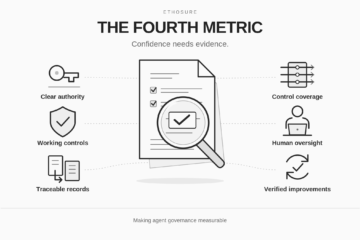
Ethosure’s approach makes governance the first thing that goes into a new agent deployment, not the last. The policy bundle is defined, the enforcement layer deploys alongside the agent, and the evidence ledger starts running from day one. The first deployment is scoped narrowly – one agent, one set of tasks, one policy bundle – and the evidence pack from that deployment is the foundation for expanding scope.
Organizations that do this report a shift in how governance is perceived internally. When the enforcement layer is frictionless and evidence is automatically produced, governance stops being what slows deployment down and starts being what makes deployment politically possible in risk-averse environments. That is the accelerator.