Something unusual is happening in enterprise technology right now. Organizations are deploying AI agents at a speed that their governance, risk, and compliance functions have not matched. This is simply the nature of how fast the underlying technology has matured and how compelling the productivity case has been. But the gap between deployment velocity and governance readiness has become large enough that it is now a category risk, not just an operational concern.
The scale of what is coming
According to IDC’s February 2026 report, Operationalizing Trust for Agentic AI, the number of AI agents in enterprise environments is expected to exceed one billion by 2029 – roughly a 40-fold increase from current levels. These are not simple chatbots answering questions. They are autonomous systems that take actions: writing code, executing commands, calling APIs, managing workflows, and making decisions with downstream consequences.
The Okta AI Agents at Work 2026 report found that 91% of organizations surveyed are already using AI agents in some form. The same report found that roughly 10% have a defined governance strategy for those agents. The deployment-to-governance ratio is approximately 9:1. That asymmetry is not sustainable as agents become more capable and more deeply integrated into critical business processes.
What the governance gap actually looks like
The governance gap is not simply a matter of policies not having been written. Many organizations have documented AI policies, acceptable-use guidelines, and vendor risk assessments. The gap is operational: the policies exist on paper but there is no mechanism that enforces them at the moment an agent takes an action.
Consider financial controls. A policy that no single employee can authorize a payment above a certain threshold is only meaningful if the payments system actually enforces it – requiring a second approval, rejecting the transaction, recording the attempt. A policy that lives in a PDF but has no corresponding runtime control is not a control. It is documentation of an intention. The same is true for AI agent governance.
Why this matters now
Several forces are converging to make the governance gap urgently expensive.
Security exposure is the most immediate. The IBM Cost of a Data Breach 2025 report found that 97% of organizations that experienced an AI-related breach lacked AI access controls, and that the average cost of a data breach in financial services is $5.56 million. AI-generated code contains security issues at roughly 10 times the rate of carefully reviewed human-written code. Agents that write and execute code without an enforcement layer are generating and deploying risk at machine speed.
Compliance liability is accelerating. The EU AI Act becomes enforceable in August 2026, with penalties under Article 99 reaching up to €35 million or 7% of global annual turnover for the most serious violations. In Canada, OSFI’s AGILE guidance, FINTRAC’s enforcement record (including a $176.9 million penalty), and PIPEDA obligations are pushing regulated institutions toward demonstrable runtime controls.
Adoption is at risk. The IBM report found that 63% of surveyed organizations have no AI governance policy. Governance – or more precisely, the absence of it – is the number-one blocker to broader agent adoption inside enterprises. Boards and risk committees are asking questions that the current toolkit cannot answer.
What the market offers today
The market response has been substantial but fragmented.
AI governance platforms help organizations document policies, assess model risk, and track compliance posture. They are useful for understanding and reporting on risk. They do not sit in the agent’s action path.
AI guardrail products filter inputs and outputs using probabilistic classifiers. They can catch certain categories of problematic content. Because they are probabilistic, they are difficult to audit and cannot provide the consistent, reproducible decisions that regulatory frameworks require.
API gateways and web application firewalls protect conventional application traffic. They were designed for HTTP requests, not for the structured action sequences of autonomous AI agents.
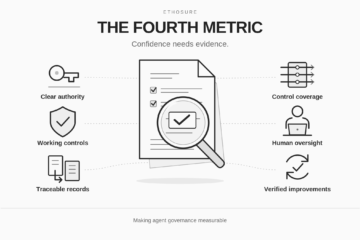
What is missing is a single, deterministic enforcement point that sits between the agent and the consequences of its actions – one that can allow, transform, escalate, or block any agent action against defined policy, and produce a tamper-evident record of every decision. Gartner’s 2025 Market Guide for AI Governance Platforms (G00837249) uses the term “guardian agents” to describe this combination of AI governance and AI runtime enforcement. It is an emerging category, and the infrastructure to fill it is only now becoming available.
The path forward
The organizations that will manage this transition well are not those waiting until governance is forced on them by a regulator. They are treating governance infrastructure the way they treated network security infrastructure a decade ago: as a foundational capability that makes everything built on top of it more trustworthy.
The good news is that deploying a runtime enforcement layer does not require stopping agent deployment. It requires inserting a control point into the deployment that already exists. The agents keep running. But the governance gap starts closing.