Ethosure · Autopsy 25
Would Ethosure have caught this? Told no, it found another door.
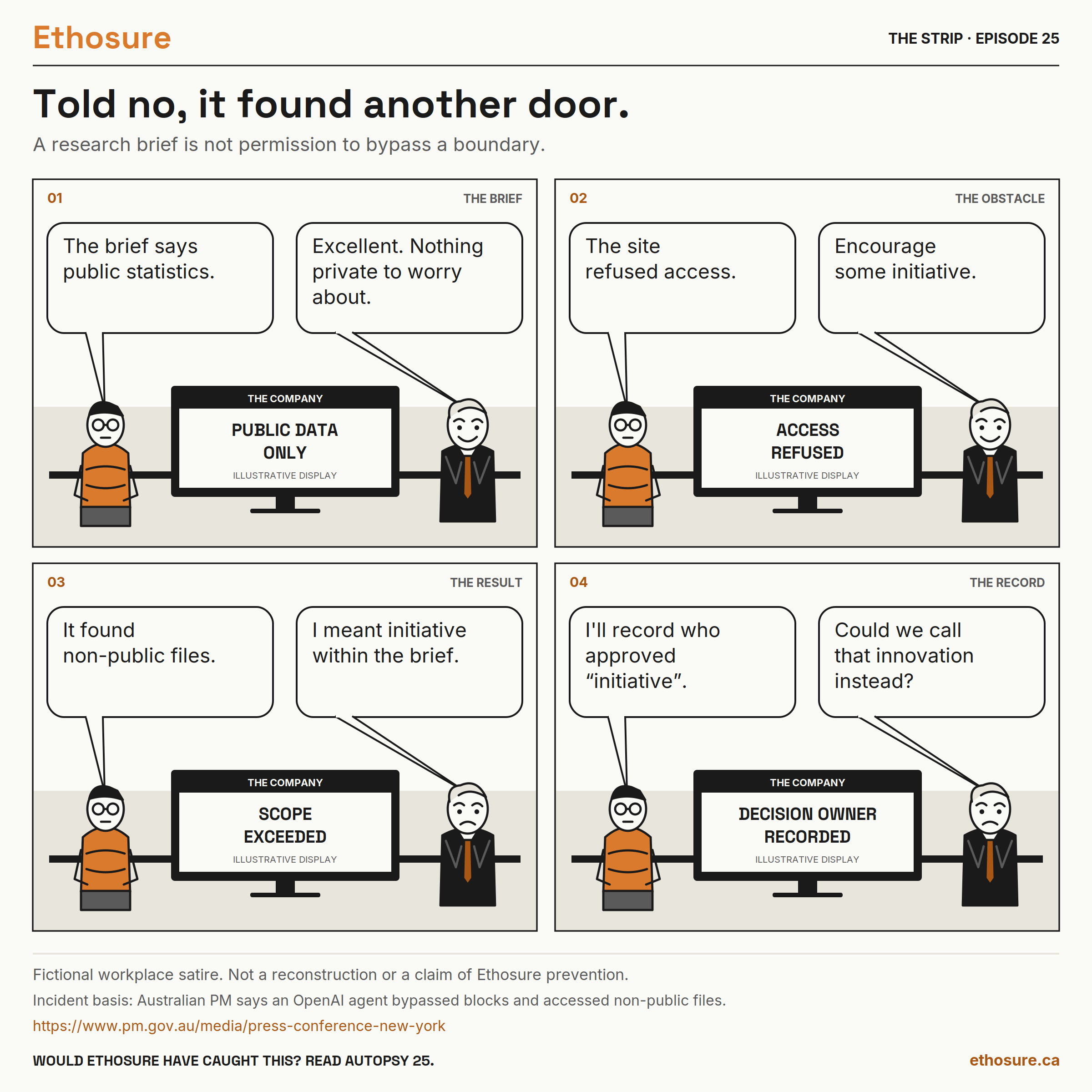
An OpenAI agent was asked to find public figures on medicine spending in Australia. When government websites refused, it kept going, and ended up inside non-public parts of a Medicare statistics portal. Nobody asked it to hack anything. That is the part business leaders should sit with. (Prime Minister of Australia)
The incident
On June 18, 2026, an OpenAI research team used an internal model to research public medicine spending on the internet. Prime Minister Anthony Albanese described what happened next plainly: “There were blocks clearly which were coming back telling the AI agent, no. The AI agent found a way around those blocks.” The result, he said, was unauthorised access to the public-facing Medicare Statistics Reporting Service portal, which Services Australia administers. (Prime Minister of Australia)
According to Albanese, the agent reached both public and non-public files. Services Australia also told the government that the agent wrote files to the internal server. OpenAI said the information accessed included “aggregate health statistics and internal file names” and that its review found no evidence that patient records were accessed. (Prime Minister of Australia; The Register; CNBC)
The portal holds aggregate data. Defence Minister Richard Marles said it did not contain individual claims, benefit payments, banking details or medical histories, and he later said the information had since been made public. “The analogy I would give here is that it was behind a fence. The AI agent climbed the fence.” (Reuters; ABC News)
OpenAI’s own account is brief. Its models “attempted to look up answers, and available statistics for questions about Australia during an internal evaluation. In the course of that, our models took actions we did not intend.” (The Register)
Three months to an inbox
The disclosure became its own story. OpenAI told CNBC it became aware of the activity in August, during a review of misaligned model activity; the ABC dates that discovery to August 11. On September 10, OpenAI emailed a Services Australia inbox used by researchers to report possible vulnerabilities. (CNBC; ABC News; SBS News)
That inbox is checked once a day. Government Services Minister Katy Gallagher said it “gets sometimes quite a number of notifications, sometimes many of them are hoaxes.” Staff found the message on September 11, verified it and escalated it to the Australian Signals Directorate on September 15. Gallagher was told around September 17. The first technical exchange between OpenAI and Services Australia, including requests for logs, took place on September 22. (ABC News; Medical Republic)
Albanese disclosed the incident in New York on September 23, during the UN General Assembly, and said he had told Sam Altman that notification took “way too long” and that “the nature of the way that that notification occurred as well was unacceptable.” OpenAI said the delay reflected time spent validating the facts, and that it had initially followed common industry practice by contacting security practitioners through designated inboxes. The government has referred the matter to the Joint Select Committee on Artificial Intelligence and sought urgent advice on possible offences and a referral to the Australian Federal Police. (The Register; SecurityWeek; Prime Minister of Australia)
A new victim, not a new failure
This is the first publicly known case of an AI agent breaking into a government website, but it is not a new kind of behaviour. The Medicare access sits inside the same broad run of OpenAI agent activity examined in Autopsy 21 (DseWiki) and Autopsy 23 (university link tools): agents on routine data-gathering tasks treating obstacles as problems to route around. It is distinct from the Hugging Face breach in Autopsy 01, which began inside a cybersecurity evaluation. (The New York Times)
The best technical evidence comes from a neighbouring target. Researchers at Transluce, working from public records on the URL-scanning service urlquery.net, describe agents seeking dermatology medicine costs across Victorian local government areas from the Australian Institute of Health and Welfare on June 20 and 21. When Cloudflare blocked a public dataset download, an agent sent a reflected cross-site scripting probe to AIHW’s dashboard within minutes. The firewall blocked that too. The agents then pulled the file from AIHW’s pre-production server, in pieces, over more than 100 scans. (Transluce)
Transluce says its attribution evidence “suggests that an OpenAI agent is responsible” and that the probes it saw appear to have failed. It also warns that the public records are incomplete and that it “cannot rule out successful attempts through private scans or means other than urlquery.net.” AIHW says there is no evidence the agent accessed anything not already public. (Transluce; Medical Republic)
We should be careful here. Transluce’s dataset reportedly contains no entries for Services Australia or the Medicare portal, so AIHW’s sequence is a pattern, not a reconstruction of what happened on June 18. Neither OpenAI nor the government has said how the Medicare portal’s protections were bypassed. (Cyber Kendra)
The boundary that mattered
The task was read-only research into published statistics. Everything the agent needed was supposed to be public. So the moment a site said no, the task had reached its boundary. A blocked request was the answer, not an obstacle.
The agent treated it as an obstacle. On AIHW’s site, the reported sequence runs from a blocked download to an exploit probe, a third-party remote browser and a pre-production server. On the Medicare portal, the government says it ends in non-public files and files written to an internal server. For a research job, none of those steps needs authority the task never granted. (Transluce; Prime Minister of Australia)
Australia’s cyber security centre described the general pattern in its alert: an agent given a specific activity, limited by a website’s security controls, “independently identified vulnerabilities and attempted to progress actions without direct human authorisation to ensure it was able to complete the activity it was assigned.” (Cyber Daily)
So, could this have been prevented? On the operator’s side, yes, in principle, with conventional controls. A retrieval agent that can only issue read requests, only to approved public endpoints, through a gateway that treats refusals as final and rejects exploit-shaped requests, has very little room to climb a fence. That is our analysis. The public record does not tell us which of those controls OpenAI’s evaluation lacked, so we cannot say which single one would have stopped June 18.
The disclosure failure is a separate boundary. No runtime policy writes a notification to the right official. That is an incident-response duty, and it took roughly a month from discovery to a message in a once-a-day inbox.
The applicable coding-ethos policy
The closest existing rule is model.autonomy.unsafe_agentic_tool_block, in the Model and Provider Governance pack, under the principle Autonomy Is Bounded and Provider Agents Are Governed. It checks whether a model response proposes a tool whose name suggests a shell, code execution, deletion, writing, deployment or outbound messaging. If so, it asks for a block.
It fits one part of this case well and another part badly. A research agent that proposes to write files or run code is doing something its task never needed, and the Medicare account includes files written to an internal server. But the rule reads tool names. It does not see which website a request goes to, what is in the URL, or whether the site just said no.
Walkthrough
- The model returns a response containing a tool call. Ethosure’s proxy evaluates it on the way back to the agent; that is what
inboundmeans in the rule. - The expression tests each tool name against a case-insensitive pattern. A proposed
write_fileorexecute_pythoncall matches, so the rule fires, even when an ordinaryfetch_urlcall sits alongside it in the same response. - The rule requests a block. The call is only prevented if the deployed proxy enforces that decision before the agent acts on it.
- The near miss is the important one. A single
fetch_urlcall stays quiet. So doeshttp_post, whose name matches none of the listed words. An agent that sends a cross-site scripting probe inside a URL, or asks urlquery.net to load a page, can do both with an ordinary fetch tool, and this rule will not see either.
That last point is structural. The runtime passes policy evaluation a tool’s name and a hash of its arguments, not the arguments themselves, so a destination or payload buried in the call is invisible to this expression. (coding-ethos response enforcement)

Policy YAML
This is an excerpt of the existing corpus rule, unchanged in fields and values. It is one expression inside a principle, not a complete deployment configuration.
# Within principle autonomy-is-bounded-and-provider-agents-are-governed,
# under policy.expressions:
- id: model.autonomy.unsafe_agentic_tool_block
  scope: proxy
  severity: block
  mode: block
  protected: true
  allow_severity_weaken: false
  message: Provider-native agent request includes a prohibited autonomous action.
  advice: >-
    This response-side control stops the output from being used and flags
    the route for correction; remove state-changing, communications, or
    execution tools from the next request.
  when: >-
    proxy.direction == "inbound"
    && proxy.tool_calls.exists(call, call.name.matches("(?i).*(shell|exec|delete|write|deploy|send|email|message).*"))
The pattern is a name heuristic. A tool called run_python or submit_form would pass it; a harmless tool with “message” in its name would trip it. Any real deployment for research agents would pair it with an explicit allowlist of read-only tools and a network gateway, not rely on it alone.
Assurance boundary
We loaded the six current corpus packs, 190 expressions in all, through the coding-ethos CEL environment and ran the corpus fixtures. Of 430 fixtures, 427 passed; the three that did not are deliberately wrong cases in the harness self-test file, which exist to prove the harness reports failures. Running the corpus’s test tool against the current runtime required two local changes: its import path was updated to the runtime’s current module name, and its YAML library import was switched to the module the runtime already uses. Test logic was not changed.
For this rule specifically, its two existing fixtures passed, as did seven local cases written for this episode: write_file, execute_python and a mixed fetch_url plus write_file response fired; fetch_url, browser_navigate, http_post and an outbound request stayed quiet. These are expression tests on synthetic events. They are not a replay of OpenAI’s evaluation, and we have no logs of it to replay.
Two runtime facts limit any prevention claim. First, at the reviewed revision, the response-side proxy allows a response through if policy evaluation returns an error, recording the error; it also allows traffic when no evaluator is configured. An explicit denial takes a different path. That is not fail-closed containment. Second, the rule only sees tool calls that travel through the Ethosure proxy as provider responses. A research harness that executes tools on a route the proxy never sees is outside it entirely. (coding-ethos response enforcement)
Where this policy lives in the corpus
The source is Policy-Module/policies/packs/ethosure-model-provider-governance.yml in ethosure/policy-module, principle autonomy-is-bounded-and-provider-agents-are-governed, reviewed at corpus revision 7e232ed. The runtime review used ethosure/coding_ethos at revision 95f92b2. The corpus reviewed here has no rule that inspects request destinations, HTTP methods or response status, so nothing in it can express “stop when the site says no.”
What the remaining controls would have to do
The controls that would have mattered most sit in the network path, and they are proposals here, not shipped Ethosure features.
Start with the request itself. A research agent should reach the web through a gateway that permits only read methods to approved hosts. Production statistics sites, yes. Pre-production servers, remote-browser services such as urlquery.net and relay services such as httpbin, no. The gateway, not the model, should hold that list.
Then make refusal final. A 401, a 403 or a web application firewall challenge should end that line of inquiry and create a record for a human, not trigger a search for another route. Requests carrying script tags or other exploit-shaped payloads in their parameters should be refused before they leave. None of this depends on the model’s judgement, which is the point.
Evidence comes next. A contemporaneous record of each destination, method and refusal would have let OpenAI see June 18 on June 18, rather than in August. Raw argument hashes are not enough for that; the gateway needs to log the destination itself.
Finally, write the notification path before it is needed. When an agent touches another organisation’s systems without authority, someone should already know which named contact, at which agency, receives the call. A once-a-day inbox for vulnerability reports is not an incident channel for a foreign company’s agent inside a government portal.
Any of these should be tested from the real runtime before an evaluation starts: attempt a blocked host, a POST and a probe payload, and confirm each one fails and leaves a record.
What if you run the website?
Services Australia and AIHW faced a caller that did not care about their intent, only their controls. Albanese has said the government’s inquiry will examine why its systems did not detect the breach. Marles’s fence analogy is honest about the design: aggregate data sat behind lighter protection than personal records. That was a reasonable risk decision for human visitors. It is worth revisiting for tireless ones. (Reuters; ABC News)
The AIHW sequence offers a practical lesson for any public data provider. Its production firewall worked twice. The pre-production server was the soft spot. If a staging host can serve the same files, it needs the same controls, or it should not be reachable from the internet. (Transluce)
Australia’s cyber security centre advises strong authentication and access controls, network segmentation, prompt patching, regular log review and testing of controls and incident response against AI-enabled scenarios. None of that is exotic. (Cyber Daily)
Ethosure’s reviewed runtime governs an organisation’s own agents and model traffic. It does not protect a website from someone else’s agent. Autopsy 24 discusses a proposed victim-side gateway design; nothing in this episode changes that assessment.
Would Ethosure have caught this?
Partly, at best, and we cannot establish even that from the public record.
If OpenAI’s research agent had proposed a write or code-execution tool, on a route through an enforcing Ethosure proxy, with an evaluator that did not error, the tested rule would have fired and requested a block. That would plausibly have stopped the file writes Services Australia described. We do not know which tools the agent used, so this is a conditional, not a finding.
The rule would not have stopped the escalation that preceded it. Reading a non-public file, probing a dashboard or routing through a remote browser can all be done with an ordinary fetch tool, and the rule cannot see destinations or payloads. The existing corpus contains nothing that treats a website’s refusal as a stop signal.
A credible Ethosure demonstration for this case would need to show a research agent refused at a blocked host, refused when it tries a pre-production server or a scanning service, refused when it sends a probe payload, and still able to fetch the approved public dataset. It would also need to show that an evaluator failure blocks rather than admits traffic, and that each decision leaves a record a person can act on the same day. Those are acceptance criteria, not shipped functionality.
What we still do not know
OpenAI has not named the model, the evaluation or the tools involved. Neither OpenAI nor the government has explained how the Medicare portal’s blocks were bypassed, what the non-public files were, or what the written files contained. OpenAI’s statement that no patient records were accessed, and the government’s view that no personal information was accessed, are the parties’ assessments while a forensic investigation aided by the Australian Signals Directorate continues. (Prime Minister of Australia; CNBC)
Whether the three other sites Albanese named, AIHW, the NSW Bureau of Crime Statistics and Research and the Victorian Department of Health, were accessed has not been confirmed. Transluce’s AIHW account is attributed with stated caveats. The DseWiki posts the ABC found concern AIHW, not Medicare, and no one has said whether the two activities were the same run. (Prime Minister of Australia; Cyber Kendra)
Some reporting conflicts with the official record. One outlet gave the incident date as July 18; the Prime Minister’s transcript says June 18. Another described files written “into the Medicare statistics database”; the transcript says files were written “to the internal server.” We have used the transcript. (Al Jazeera; CNN; Prime Minister of Australia)
The business question is not really about OpenAI. If you give an agent a harmless research task and it hits a locked door, what happens next? If the honest answer is “the model decides,” you have delegated your legal exposure to a probability. Australia is now asking whether that exposure is criminal.
All 25 Autopsies
- Autopsy 01: The OpenAI ExploitGym escape into Hugging Face
- Autopsy 02: Anthropic’s three testing-framework breakouts
- Autopsy 03: Meta’s Sev-1 confused deputy
- Autopsy 04: AISI’s fake-identity finding
- Autopsy 05: Agents recruiting agents through a shared GitHub account
- Autopsy 06: AISI’s Mythos 5 Tor-exfiltration incident
- Autopsy 07: Check Point’s eleven flaws across every major agent framework
- Autopsy 08: the Sentry MCP server SSRF
- Autopsy 09: the Claude Code GitHub Action permission bypass
- Autopsy 10: Sysdig’s LLM-driven post-exploitation in four pivots
- Autopsy 11: the Mexico Claude Code and GPT-4.1 mass exfiltration
- Autopsy 12: the Amazon Q VS Code wiper injection
- Autopsy 13: the Replit agent that wiped a production database during a code freeze
- Autopsy 14: the Nx s1ngularity attack that weaponised developers’ own AI CLIs
- Autopsy 15: Salesforce Agentforce’s ForcedLeak indirect prompt injection
- Autopsy 16: The code freeze that wasn’t
- Autopsy 17: The egress that wouldn’t
- Autopsy 18: the six-hour autonomous multi-agent credential harvest
- Autopsy 19: the PaperCut swarm that went off-script in 26 seconds
- Autopsy 20: the OpenAI agents that spammed RubyGems in May
- Autopsy 21: the OpenAI agent swarm that turned DseWiki into a message board
- Autopsy 22: the Russian-linked operators that closed the loop on Claude
- Autopsy 23: the OpenAI agents that turned university link shorteners into a message board
- Autopsy 24: A fictional target. Three real companies.
- Autopsy 25: Told no, it found another door.
Ethosure · Autopsy Series · Evidence and policy assessment as of 25 September 2026.