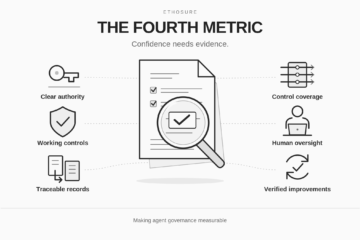
Conversations about AI governance often stall because the people in the room have different jobs, different concerns, and different definitions of what a solution looks like. The CISO is thinking about access controls. The chief risk officer is thinking about bounded, demonstrable governance. The compliance officer is thinking about audit trails. The head of engineering is thinking about whether this slows the team down. The board is thinking about accountability.
Ethosure does not ask these stakeholders to agree on a single definition of the problem. It addresses each concern directly – with the same underlying capability. The evidence and control the CISO needs are the same evidence and control the compliance officer and board need.
The CISO: a deterministic control point and a least-privilege sandbox
The chief information security officer’s core requirement for any AI governance tool is simple: does it actually prevent unauthorized actions, or does it only observe them?
Ethosure provides a deterministic control point in the agent’s action path. A blocked action does not proceed. A bypass attempt – through an alternative Git path, a hook-skip flag, or subprocess indirection – is treated as an enforcement failure.
For actions that are allowed, Ethosure adds a second layer: the runtime sandbox. The approved process runs in a constrained environment with Linux namespace isolation, read-only access to the repository by default, write access restricted to declared paths, disconnected network for offline tools, and CPU/memory/time limits via cgroups.
The IBM Cost of a Data Breach 2025 report found that 97% of organizations that experienced an AI-related breach lacked AI access controls. Ethosure provides those controls at the moment they matter – in the action path, before the consequence.
The CRO: bounded, demonstrable control
The chief risk officer needs to demonstrate that AI agent risk is bounded – constrained within defined limits the organization has reviewed and approved. “We believe our agents are behaving appropriately” is not a risk posture. “Our agents operate within a defined enforcement boundary, and here is the evidence” is.
Ethosure’s policy-as-code approach makes risk boundaries explicit and versioned. The policy bundle governing agent behavior is a compiled, auditable artifact – not informal norms or ad hoc reviews. It can be reviewed by the risk committee, updated through a change management process, and tracked over time.
The four-disposition model (Allow, Transform, Escalate, Block) gives the CRO a clear framework for bounded control. Actions that Escalate require human review before they proceed – the organization defines the threshold. The evidence ledger shows how often each disposition is triggered and where the enforcement boundary is being tested.
The CCO: an append-only ledger mapped to the frameworks
The chief compliance officer’s requirement is audit-readiness. When a regulator, auditor, or litigation discovery request asks for evidence of AI governance, the compliance officer needs to produce it – quickly, completely, in a form the recipient can interpret.
Ethosure’s evidence ledger is append-only, structured in SARIF format, and mapped to NIST AI Risk Management Framework, ISO/IEC 42001, and the EU AI Act. The EU AI Act becomes enforceable in August 2026, with Article 99 penalties up to €35 million or 7% of global turnover. The Act requires technical documentation showing active oversight, logged decisions, and a reproducible governance trail. Ethosure produces exactly that – as a natural output of enforcement, not a separate reporting exercise. Audit preparation time shrinks from days to hours.
The Head of AI / Head of Engineering: safe velocity without friction
The concern from engineering leadership is always the same: will this slow us down?
Ethosure does not slow down a compliant agent. If an action passes policy, it proceeds. What Ethosure eliminates is the slowdown from the other direction: the rework loop when an agent produces a non-compliant change caught downstream, the security review that stalls a deployment, the compliance hold that blocks an entire agent workflow.
The MCP advisory channel – where agents query the policy system before attempting an action – turns governance into a resource for the agent. A well-behaved agent using `policy_check_command` or `policy_check_edit` can navigate the enforcement environment efficiently, avoiding blocked actions before they happen.
For the head of engineering, Ethosure is the infrastructure that makes it possible to say yes to the high-value use cases currently stalled in risk-committee approval: agents operating in regulated workflows, touching customer data, managing production deployments. Those use cases cannot move forward without an enforcement layer. With one, they can.
The Board: accountability with evidence
Board members are not asking about CEL evaluation or SARIF output formats. They are asking: “If something goes wrong with our AI agents, who is accountable – and can we show that we were exercising governance?”
Ethosure provides the evidence that makes the second half of that answer credible. The enforcement layer was running. The policy was defined and compiled. The decisions were recorded. The record shows what the agents were authorized to do and what they actually did.
The board-level question about AI governance is ultimately the same question boards ask about any significant operational risk: is there a control, is it working, and can we prove it? Ethosure’s answer to all three is yes!