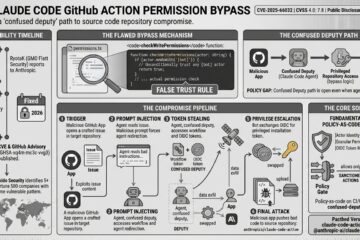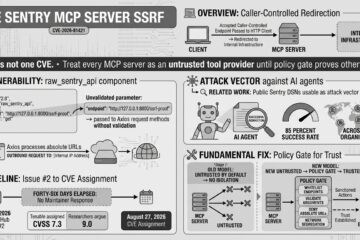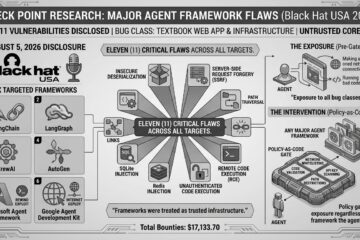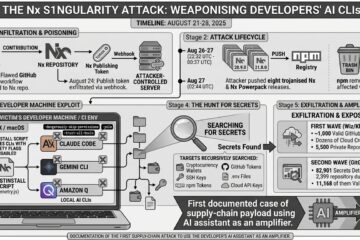
AI has moved into the control plane. Governance is now the price of scale.

Enterprises and governments are no longer piloting AI. They are embedding it into decisions, code, and customer contact. Yet three out of four organizations still cannot move AI reliably from pilot to production, and new regulation is arriving faster than most internal controls. Ethosure exists to close that gap. (Note: you can download this factsheet – no registration required.  The link is in the toolbar inside the document window.  On the right hand side, look for Read more

Six things a CISO must own in the age of autonomous AI.

RSAC 2026 marked the moment agentic AI moved from experimentation to operational reality. The threat surface has moved with it. This is the priority stack the world’s security leaders are being asked to build, in order, in 2026 and 2027. The RSAC 2026 signal is unambiguous: agentic AI is a control-plane issue, and CISOs are being asked to move from static perimeter tools to continuous, identity-anchored, runtime governance. Ethosure builds the operating layer that makes Read more

Regulators are already writing the AI enforcement playbook.

The EU AI Act’s headline fines have not started flowing yet. But data-protection authorities and consumer-protection regulators have been enforcing against AI systems for years. Here is the record so far. Every entry links to the primary regulator’s own file. 13 – AI-washing cases filed by the FTC €7.1B – Cumulative GDPR fines since May 2018 30+ bn – Face images in the largest sanctioned AI database Regulators are not waiting for a horizontal AI Read more

AI Governance: 8 jurisdictions. 4 regulatory postures. 1 shared direction.

The world is not converging on a single AI law. It is converging on a set of expectations: identify AI use, manage risk, disclose to users, and prove it. This is where the major jurisdictions stand as of August 2026 Whether it arrives as a horizontal act, a sectoral rulebook, or a regulator’s advisory, every serious jurisdiction is asking for the same four things: an inventory of AI use, a documented risk assessment, disclosure to Read more

The Regulatory Timeline: past, present, and future of AI Governance

A dated map of the AI regulations that have already shaped enterprise practice, the obligations that are live right now, and the compliance dates already written into law. Every entry cites a named regulator or a published statute. Regulation is arriving in overlapping waves, not a single deadline. The Article 50 transparency layer is live today. The OSFI E-23 clock has started. The EU high-risk deadline has moved, not disappeared. Ethosure builds the lifecycle controls, Read more

Governments are mandating AI oversight. Enterprises are stalling.

Two very different maturity curves. Federal civilian agencies are being pushed by executive mandate to embed governance into every AI deployment. Enterprises are still treating governance as a compliance task, and progress has flattened since 2024. This is what the divide looks like in 2026.   (Note:  you can download this factsheet – no registration required.  The link is in the toolbar inside the document window.  On the right hand side, look for the “PDF” Read more

Schools have guidance, not AI regulation. Every institution is on its own.

Unlike healthcare or financial services, post-secondary education has no dedicated AI regulator with enforcement powers.  What exists is a growing library of voluntary principles and departmental letters. The consequence is that every campus is writing its own rulebook, and every faculty of law, medicine, and education is grading it in real time.     (Note:  you can download this factsheet – no registration required.  The link is in the toolbar inside the document window.  On Read more

Trust is not a message. It is an AI architecture.

EY’s Trust as Architecture study finds that resilient enterprises stop treating trust as brand narrative and start engineering it into how AI is built, procured, and operated. This is what the stack looks like when it works; this is Ethosure’s position: policy as code, trust as architecture. Some statistics to support trust as code: $10.2M – Average data breach cost 49,000 –  Vulnerabilities disclosed in 2024 <29 min – Fastest recorded breakout time from access Read more

Healthcare has 1,451 AI devices and one shifting rulebook.

The FDA has authorized more AI-enabled medical devices than any other regulator in the world. The rules governing how they are updated, disclosed, and monitored are being rewritten in real time, and not always in the direction of stronger oversight. 1,451: FDA-authorized AI/ML devices, cumulative through Dec 2025 76%: Share concentrated in radiology imaging 295: New authorizations in calendar year 2025, a record 0: Generative-AI or LLM-powered devices authorized to date (Note:  you can download Read more

What every regulated bank, credit union, and insurer needs in place for AI Governance

A six-layer view of the controls, roles, and reporting lines that a Canadian federally regulated financial institution (FRFI) will be expected to demonstrate under OSFI Guideline E-23, with parallel obligations from the CFPB, NYDFS, and the EU AI Act for cross-border activity.  Proper AI governance demands this. (Note:  you can download this factsheet – no registration required.  The link is in the toolbar inside the document window.  On the right hand side, look for the Read more

Subscribe to Ethosure's Newsletter to get monthly updates on AI Governance

We don’t spam! Read our privacy policy for more info.