Imagine two versions of a fire suppression system. The first version, when it detects heat above a threshold, activates the sprinklers – every time, without exception. The second version analyzes the heat pattern, consults a learned model, and usually activates the sprinklers – but sometimes decides it was probably just someone cooking, so it waits. Which system would you trust with your building?
This is the difference between deterministic and probabilistic decision-making, and it is at the heart of how Ethosure governs AI agents. The choice between these approaches is not just a technical preference – it determines whether your governance is something you can rely on, audit, and defend.
What deterministic means
A deterministic system is one where the same input always produces the same output. A calculator is deterministic: 2 + 2 will always equal 4, regardless of what time it is, how many times you have asked before, or what mood the calculator is in.
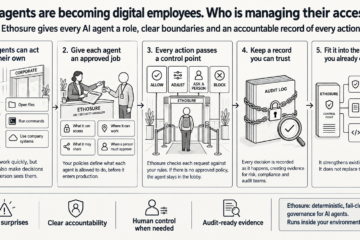
Applied to AI agent governance, deterministic means: given the same proposed action and the same compiled policy, the system returns the same decision every time. “Block commands containing `–no-verify`” is a deterministic rule. It does not matter which AI model generated the command, how confidently it was proposed, or what the history of the session looks like. The flag is either present or it is not.
What probabilistic means
A probabilistic system uses statistical reasoning to produce a result that is likely correct most of the time, but carries inherent uncertainty. Large language models are probabilistic – their outputs depend on patterns learned from training data, and the same prompt can produce different responses on different days.
Probabilistic approaches to security often come in the form of content filters or behavior classifiers: “does this output look harmful?” The system assigns a confidence score and acts on it. This is genuinely useful for many applications. It is not suitable as the primary enforcement mechanism for an AI governance control.
Why? Because “99% confident this was blocked” is not the same as “this was blocked.” For an auditor, a regulator, or a board member asking “how do you know the agent followed your rules?” – probabilistic confidence is not an answer. Audit evidence requires certainty about what happened, not a statistical estimate of what probably happened.
The explicit design choice in coding-ethos
The coding ethos project – the enforcement core behind Ethosure – makes this design choice explicit. Its documentation states: “Probabilistic/embedding-based enforcement is explicitly disallowed in the enforcement path.”
This means the CEL evaluators that make allow/block/transform/escalate decisions operate only on structured facts evaluated through deterministic logical expressions. CEL cannot call an AI model mid-evaluation. It cannot use embeddings (numerical representations of meaning) to guess whether something is compliant. It evaluates the same policy expressions against the same facts and returns the same decision.
This constraint applies specifically to the enforcement path – the moment of decision. The system does use embeddings and vector search elsewhere: for code-intelligence search, which helps agents find relevant prior examples and similar code. But those are search and suggestion features, not enforcement decisions. The distinction is important and intentional.
Where probabilistic tools fit
This does not mean probabilistic AI tools have no place in a governance architecture. They have important supporting roles:
Remediation suggestions. After a deterministic block fires, the system can optionally consult an AI model to generate repair advice. The advice is clearly labeled as coming from an AI model, not from the policy engine. It guides the agent toward a fix; it does not change the enforcement decision.
Code-intelligence search. Finding semantically similar prior violations, searching across past remediation outcomes, and suggesting relevant skills are all legitimate uses of vector embeddings – as long as the results are advisory and search results are auditable back to a source.
Risk summarization. Synthesizing patterns across many deterministic findings into a human-readable summary is a suitable task for AI assistance.
The rule is simple: AI model outputs can inform and assist, but they cannot be the basis for a governance decision.
The practical difference for your organization
Consider two scenarios:
- Scenario A – probabilistic enforcement. Your governance platform uses an AI model to evaluate whether an agent’s actions are compliant. The model is generally accurate. When a regulator asks why a particular action was allowed or blocked, you say “the model classified it as compliant.” When the model’s provider updates it in a quarterly release, your enforcement behavior changes – potentially without your knowledge.
- Scenario B – deterministic enforcement. Your governance platform uses CEL expressions compiled from your policy bundle. When a regulator asks why a particular action was allowed or blocked, you produce the specific policy ID, the specific fact set, and the specific CEL expression that produced the result. When the AI model’s provider updates it, your enforcement behavior does not change – because the model is not involved in the enforcement decision.
Scenario B is what Ethosure delivers. The decisions are reproducible. The evidence is complete. The audit trail holds up.
For regulated industries – financial services, healthcare, government – this is not a nice-to-have. The EU AI Act, NIST AI RMF, ISO/IEC 42001, and frameworks like OSFI’s AGILE guidance require organizations to demonstrate bounded, auditable control over high-risk AI systems. Probabilistic enforcement cannot satisfy that requirement. Deterministic enforcement can and will.