Most organizations have no shortage of written rules. There are security policies, coding standards, compliance frameworks, architectural principles, and onboarding guides. The problem is that written rules are only as good as the people – or agents – reading them. When an AI coding agent writes a thousand lines of code in the time it takes a developer to drink a coffee, a PDF of best practices is functionally useless as an enforcement mechanism.
Policy-as-code is the practice of translating written rules into structured definitions that a computer can evaluate automatically. It is not a new idea in IT – infrastructure teams have used it for years to define server configurations in code rather than click-through wizards. What coding-ethos brings to the table is applying the same principle to the layer where AI agents act: the moment a command is run, a file is edited, or a commit is staged.
Why written policies fail at machine speed
Consider a typical engineering rule: “No credentials may be committed to the repository.” Written down, everyone agrees. In practice, enforcement has historically meant either a pre-commit hook (which a developer can bypass with a flag), a CI scan (which catches the problem after the fact), or an auditor reviewing commits manually (which is expensive and slow).
Now multiply that problem by an AI agent that can propose hundreds of changes per hour, across dozens of repositories, drawing on prompts that may contain credential-like content from earlier in the conversation. The gap between “we have a policy” and “the policy is enforced” becomes a liability gap.
Policy-as-code closes that gap by making the rule itself executable. Instead of a sentence in a handbook, you have a machine-readable definition that says: “If any staged file contains a PEM private key header, block the commit and emit a finding linked to the ‘security-by-design’ principle.”
How coding-ethos implements policy-as-code
In the coding-ethos project (the open-source enforcement core behind Ethosure), policy-as-code works through a layered architecture.
Principles come first. The file `coding_ethos.yml` holds approximately 29 named engineering principles. Each principle is not just a label – it carries a directive, a summary, tags, and pointers to the detailed guidance agents and developers should follow. Examples include `fail-fast-fail-hard`, `security-by-design`, `validation-at-the-gate`, and `radical-visibility`.
Principles own their policies. Each policy rule in the system is linked back to a specific principle. A rule that blocks private key commits belongs to `security-by-design`. A rule that blocks hook-bypass flags belongs to `one-path-for-critical-operations`. This linkage is not decorative – it means every enforcement decision can be traced back to a stated organizational value.
A compiler turns principles into a bundle. The policy compiler reads the principles, any repository-specific configuration, and hook settings, then produces a single versioned JSON file called `policy-bundle.json`. This bundle is the single source of truth for every enforcement component – Git hooks, agent hooks, the MCP query server, and the runtime sandbox all read from the same bundle. There is no divergence and no “it’s enforced in CI but not locally” gap.
CEL evaluators apply the rules. CEL (Common Expression Language) is a deterministic expression evaluator – think of it as a very precise calculator that takes structured facts about an action and returns a decision. Policies are CEL expressions. “Does this command include `–no-verify`?” is a CEL expression. “Does this file edit target a protected path?” is a CEL expression. Because CEL is deterministic, the same action against the same policy always produces the same result. There is no probabilistic reasoning, no “usually blocks this,” no model-dependent behavior.
What this looks like in practice
Imagine your organization has a principle that says developers and agents must run tests before committing to the main branch. In a traditional setup, that rule lives in a document, in a CI gate that runs after the fact, and in the institutional memory of whoever does code review.
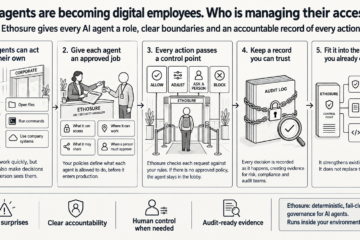
In a policy-as-code setup with coding-ethos, that rule exists as a compiled policy that the pre-commit Git hook evaluates. When an AI agent attempts a commit without a passing test gate, the hook evaluates the policy, returns a BLOCK disposition, and emits a structured finding that says: “Commit blocked. Policy: `pytest.gate`. Principle: `testing-as-specification`. Suggested fix: run `make check` before committing.”
The agent gets a deterministic, actionable response. The event is recorded in the evidence ledger with a timestamp, a policy ID, and a link to the principle it enforces. The compliance team gets a log entry they can query.
The business value
For a compliance or risk officer, policy-as-code means the gap between “we have a policy” and “we can prove it was enforced” closes dramatically. Audit evidence is not a folder of screenshots assembled after the fact; it is a structured log that was generated at enforcement time.
For a security team, it means controls that cannot be bypassed by agents who do not read documentation. An agent does not need to have been trained on your security policies – the policies run in the agent’s action path regardless.
For an engineering team, it means the rules are version-controlled alongside the code they protect, reviewed in pull requests, and always in sync with what is actually enforced. When the policy changes, the bundle is recompiled, and all enforcement surfaces update simultaneously.
Policy-as-code does not eliminate judgment – escalation to a human remains a first-class disposition. What it eliminates is the illusion that having a written policy is the same as enforcing one.
SEO Metadata
- Title: Policy-as-code: turning written rules into computer-enforced controls
- Summary: Policy-as-code translates organizational rules into executable definitions. Learn how coding-ethos implements this approach to enforce AI agent behavior deterministically at the point of action.
- Keywords: policy-as-code, AI agent policy, coding-ethos, CEL, enforcement, compliance, Ethosure, deterministic
Suggested Category: Technology Explainer