The term “sovereign AI” has become a policy talking point across dozens of countries simultaneously. What it means varies – national AI capability, domestic model development, regulatory jurisdiction – but one thread has immediate operational implications for regulated enterprises: the question of where your AI governance decisions happen, and whose infrastructure makes them.
For organizations subject to EU data protection law, Canadian privacy regulation, or any jurisdiction with data localization requirements, this is not an abstract sovereignty question. It is a compliance question with a specific, answerable technical dimension.
What data residency means for AI governance
Data residency in AI governance has two distinct concerns that are often conflated.
The first is data in transit to the model. When agents send prompts containing customer records or personally identifiable information to a hosted AI model, that data is subject to data protection obligations in the organization’s jurisdiction and potentially the model provider’s jurisdiction. Most organizations with serious data governance programs have addressed this through model selection, contractual controls, and prompt data minimization.
The second concern is less commonly addressed: enforcement decisions as data flows. If an AI governance layer routes agent actions to a hosted enforcement backend, every action crossing that boundary carries payload context. For agents processing regulated data, routing enforcement decisions through an offshore backend may create the same data residency problem as routing the underlying data. This is the sovereignty gap in most current AI governance architectures: organizations have addressed model-layer data flows but have not considered whether the governance layer itself introduces new cross-border flows.
What the Omdia Sovereign AI Primer identifies
Omdia’s Sovereign AI Primer 1 addresses data residency as a foundational requirement for regulated industries. The core insight is that sovereignty is not just about the model – it is about the entire governance stack. An organization that processes regulated data using a domestically hosted model, but routes governance and audit decisions through infrastructure in another jurisdiction, has a partial sovereignty posture that may not satisfy the spirit or letter of data residency requirements.
For financial institutions subject to OSFI’s AGILE framework, third-party dependency provisions apply to the tools used to manage AI risk, not just the AI systems themselves. PIPEDA and its provincial equivalents impose obligations on cross-border transfers of personal information. If an AI agent’s actions are evaluated by an enforcement layer transmitting context to a foreign server – even for governance purposes – the same cross-border transfer analysis applies.
Local-first as a design principle
The alternative to hosted enforcement is local-first enforcement: governance infrastructure that runs entirely within the customer’s environment, with no required connection to an external backend. Every policy evaluation, every enforcement decision, every audit log entry happens on the customer’s infrastructure, under the customer’s control, subject to the customer’s data residency regime.
This is not a niche requirement. It is what regulated industries increasingly demand. The Gartner Market Guide for AI Governance Platforms (November 2025) identifies deployment flexibility – including on-premises and local deployment – as a requirement for enterprise buyers in regulated sectors.
Local-first governance has practical advantages beyond regulatory compliance: reduced latency (no network round-trip for enforcement decisions), no third-party dependency in the agent operation path, and the ability to function in air-gapped or restricted network environments.
The air-gap dimension
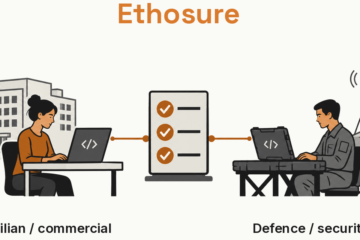
For certain regulated industries – defense contractors, government agencies, intelligence-adjacent financial institutions – even a locally hosted but externally managed service is insufficient. These environments require governance infrastructure that runs fully disconnected: no calls home, no license validation requiring network connectivity.
The `coding-ethos` architecture underlying Ethosure was designed with this requirement in mind. The policy bundle is a local file; the enforcement engine runs locally; the evidence ledger is a local artifact. No component requires a network connection to function. Deployment in air-gapped environments is not a special configuration – it is a property of the base architecture. The same local-first design that enables air-gap deployment also satisfies GDPR, Canadian privacy law, and the emerging AI governance frameworks adopting data residency as a default expectation.
The sovereignty of evidence
There is a third sovereignty dimension often overlooked: the sovereignty of the audit record. For regulated organizations, governance evidence is itself a regulated artifact. A FINTRAC examination, OSFI audit, or EU AI Act regulatory inquiry may require its production – and regulators expect it to be under the organization’s control, not a third party’s.
An audit record stored in a hosted service is subject to the provider’s retention policies, deletion schedules, and the legal jurisdiction of the service. Ethosure’s local-first, append-only evidence ledger is stored as JSONL on infrastructure the customer controls. The organization owns the record, retains it according to its own policies, and produces it without depending on a third party’s cooperation.
The practical test
Ask three questions of your AI governance infrastructure: Where are policy evaluation decisions made? Where is action context transmitted during enforcement? Where is the audit record stored?
If the honest answer to any of those is “in a third-party hosted service in a different jurisdiction,” there is a sovereignty gap that needs closing. The closing mechanism is local-first enforcement – deployed on customer infrastructure, in the customer’s jurisdiction, with no required external dependencies. That is not a constraint. For regulated enterprises, it is exactly the architecture the regulatory environment is converging toward.