Every technology adoption cycle produces cautionary tales. The early internet had companies that scaled customer data operations without encryption. Cloud adoption produced enterprises that pushed sensitive workloads to public infrastructure without access controls.
AI agents are in the “before the cautionary tales are written” phase. The deployments happening right now, in production, at scale, without enforcement infrastructure – those will show up in future case studies about what not to do. The question for any organization deploying agents today is: are you building the cautionary tale, or the model others will follow?
The adoption curve is real
IDC’s February 2026 *Operationalizing Trust for Agentic AI* projects over one billion deployed AI agents by 2029 – a roughly 40-fold increase from today. Okta’s AI Agents at Work 2026 survey found 91 percent of organizations already using AI agents, but only around 10 percent with a coherent governance strategy. That gap – 91 percent deployment, 10 percent governance – is an industry running significantly faster than its safety infrastructure.
The deployment pressure is real and the competitive logic for speed is sound. Organizations that deploy agents effectively do move faster. The business case for speed is not wrong. What is wrong is the assumption that speed and safety are in tension.
The speed-safety tradeoff is a design choice
The tradeoff exists in a specific governance architecture: one where safety is implemented as a human review process running in series with deployment. In that design, every safety step adds latency.
The alternative is runtime enforcement: governance that runs in parallel with the agent, not before it. An agent deploys immediately; the enforcement layer accompanies it from the first action. Policy evaluation happens in milliseconds, not days. Actions within scope proceed without friction; actions outside scope are blocked or escalated before they cause harm. The developer does not wait for governance review – governance happens continuously, invisibly, at machine speed.
This is the “safe velocity” architecture. It is not a compromise between speed and safety; it is the design that makes both possible simultaneously.
What the absence of enforcement actually costs
The IBM Cost of a Data Breach 2025 found that 97 percent of organizations that experienced an AI-related breach had lacked AI access controls. The average breach cost in financial services was $5.56 million – before accounting for regulatory sanctions, which under the EU AI Act can add another €15–35 million for high-risk AI system violations.
Those numbers describe the cost of speed without safety. There is also a less visible cost: the deceleration after an incident. Organizations that experience a serious AI governance failure often impose restrictive manual review processes across all agent deployments. The program that was delivering velocity grinds to a halt while governance is retrofitted under pressure – a retrofit invariably more expensive and less effective than governance built in from the start.
The operational attributes of safe velocity
An agent deployment that achieves safe velocity has four characteristics:
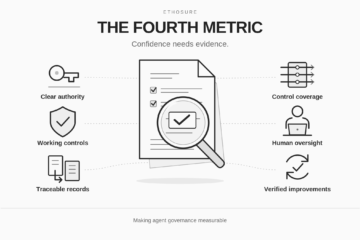
Policy-first deployment. The agent’s permitted scope is defined before deployment in a versioned policy specifying what actions are allowed, what data can be accessed, and what escalation paths exist.
Enforcement at the action level. Every agent action is evaluated against the active policy before it executes – a real-time decision, not a batch review. Actions within scope proceed; out-of-scope actions are handled by their disposition.
Fail-closed defaults. When the enforcement layer encounters an ambiguous input, the default is to deny – not allow and log. A governance system that fails open provides a false sense of security.
Continuous evidence. Governance evidence is produced automatically and continuously, not assembled for audits. This is what makes expansion credible: when a team wants to add a new capability, the governance record for existing deployments provides the foundation.
Ethosure’s approach to the pilot problem
Ethosure’s recommended entry point is a scoped design-partner pilot: one agent, already in production, with a policy bundle deployed alongside it. The pilot produces an evidence pack – a complete record of agent actions, governing policies, and enforcement outcomes – within the first few weeks.
That pack serves two purposes: it demonstrates the governance layer is working (satisfying risk and compliance teams), and it shows what the agent is actually doing in production – often surfacing scope assumptions that have shifted since deployment.
The organizations that reach safe velocity fastest start with a single well-instrumented pilot, calibrate policy from the evidence, and expand from a validated foundation. That is not the slow path. It is the fast path that does not produce the cautionary tale.
The test question
For any agent currently in production: if a regulator asked you today to produce evidence of what this agent did last week – what actions, what policies, what was permitted and what was blocked – how long would it take?
If the honest answer involves reconstructing logs, asking the engineering team to pull something together, or acknowledging the evidence might not exist at all – the deployment has speed but not safe velocity.
The goal is to answer that question in minutes, from an automatically produced record, with no reconstruction required. That answer is what separates the model from the cautionary tale.